
You are driving to work in Dubai when the AC feels weaker or an unfamiliar sound interrupts your commute. The car still runs, so you put off a workshop visit. It is an easy decision until the problem starts affecting your daily routine.
Good maintenance begins with your manufacturer’s schedule, service history and driving conditions. Dubai’s heat, dust and stop-start journeys make those details worth discussing with your technician.
This guide explains what needs checking, when servicing is due and how to plan ahead. If you need help, bring your service records to our car garage in Dubai so recommendations can be based on your car’s actual condition.
Start With Three Questions
Everything below follows from these:
- What does your manufacturer’s schedule say? It is in your handbook, and it is the only authoritative answer for your specific car.
- What has already been done, and when? Your service history tells you what is actually due rather than what a package is selling.
- How do you drive? Mostly short school runs, or long Abu Dhabi commutes? The two wear a car very differently.
Nobody can give you a schedule without those three. Anyone who quotes you one without asking is selling a package, not servicing your car.
Why UAE Conditions Change the Schedule
Your car’s service intervals were set by engineers testing in moderate climates. Five things here fall outside those assumptions.
Heat:
Sustained high temperatures degrade engine oil faster, shorten battery life, and harden rubber components — hoses, bushings, belts and seals.
Dust:
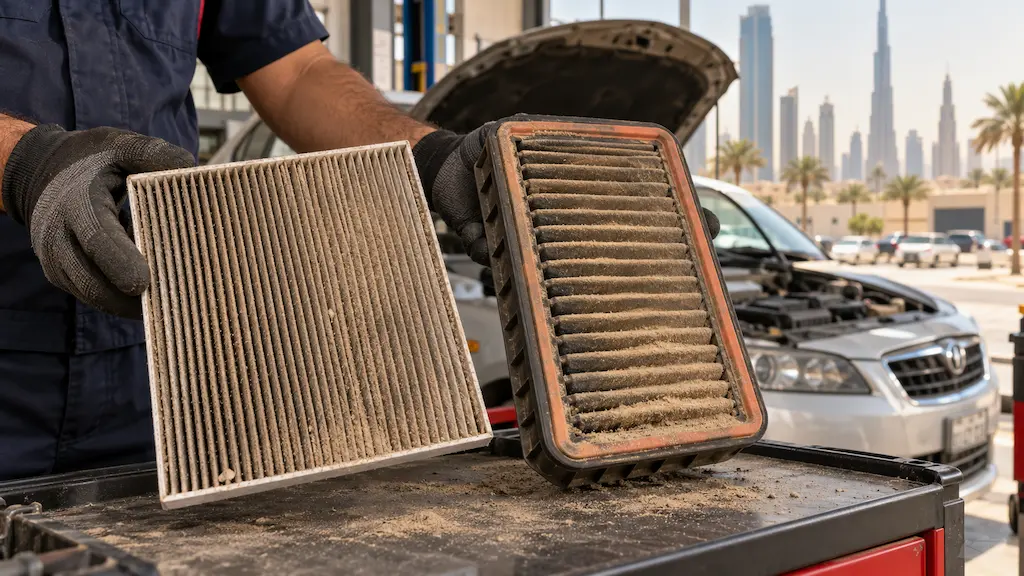
Fine desert dust clogs engine and cabin air filters considerably faster than in most markets. A restricted filter makes the engine work harder and reduces cabin air quality.
Stop-start traffic:
Constant acceleration from standstill is harder on the engine, transmission and brakes than steady cruising.
Short trips:
An engine that never reaches full operating temperature does not burn off moisture and contaminants in the oil. Short daily journeys age oil faster than the odometer suggests.
Sustained high speeds:
Long highway runs at 120 km/h put real load on the cooling system, tyres and brakes.The practical result is simple: in the UAE you generally service earlier than the book interval, not later. Servicing earlier is never a problem. Servicing later, or using the wrong specification parts and fluids, is what causes both mechanical damage and warranty disputes.
What Goes on your Schedule, and When
This is the part most guides get wrong. They present everything in kilometers. But several important items come due by date, regardless of how far you have driven which matters a great deal in a city where plenty of cars cover modest annual mileage while sitting in extreme heat.
| Item | Typical interval | Time or distance | UAE note |
|---|---|---|---|
| Engine oil and filter | 5,000–10,000 km, or 6–12 months | Whichever comes first | Heat and short trips push this to the shorter end |
| Engine air filter | Every 10,000–20,000 km | Distance, but inspect by time | Dust often means earlier than the book says |
| Cabin air filter | Around every 12 months | Time | Dust and AC use make this a real comfort item |
| Brake fluid | Typically every 2 years | Time | Absorbs moisture whether you drive or not |
| Coolant | Per manufacturer, often 2–5 years | Time | Degrades with heat exposure |
| Brake pads and discs | By wear, inspect every service | Wear | Stop-start traffic accelerates wear |
| Tyres | Inspect monthly; replace by wear and age | Both | Heat degrades sidewalls before tread wears out |
| Battery | Typically 2–3 years in the UAE | Time | Heat is the main killer, not age alone |
| Spark plugs | 30,000–100,000 km by type | Distance | Check the specification, not a generic figure |
| Transmission fluid | Where serviceable, per schedule | Varies | Many modern units are sealed |
| AC service | Check annually before summer | Time | Cheaper to fix in March than July |
| Wheel alignment | After kerb strikes, or annually | As needed | Dubai’s speed bumps cause plenty |
If you take one thing from this table: a low-mileage car still has maintenance due. Brake fluid, coolant, battery, tyre age and AC service do not care how far you drove.
Minor, major, and what the names actually mean
When you call a garage, you will be offered a “minor service” or a “major service”. Those are not manufacturer terms, they are workshop package names, and what they contain varies between garages.
Broadly, a minor service covers the oil, the oil filter and an inspection. A major service adds the longer-interval items that are now due: more filters, spark plugs, brake fluid and a deeper check.
But the names are not standardized, which is why quotes for the same car can differ several times over. We explain this fully in minor vs major car service in Dubai, including what each actually includes, why prices vary so widely, and how to tell which one your car is genuinely due for.
The short version: compare item lists, not package names.
The Checks You Can Do Yourself Between Services
Five minutes a month catches most developing problems early.
Engine oil level:
The single most valuable check, and almost nobody does it between services. Our step-by-step guide to checking the oil level in your car covers the method and what the color tells you.
Tyre pressure and condition:
Check monthly when cold, against the figure on the driver’s door jamb. Look at the tread wear pattern and the sidewalls, not just the pressure.
Coolant and washer fluid levels. Visible in their reservoirs, engine cold.
Lights:
Walk around the car with someone pressing the brake pedal.
Listen and feel:
New noises, vibrations or changes in braking feel are information. Our guide to the four warning signs you shouldn’t ignore covers what each usually means.
Watch where you park:
Fresh fluid patches on the ground are worth investigating. If your car has an automatic gearbox and you notice hesitation or rough changes, checking the gearbox oil level is a reasonable first step though the correct method varies by transmission, and some are sealed.
Warning Signs that Override the Schedule
Some things do not wait for the next service.
- A flashing check engine light, stop driving and get it checked; it usually indicates a misfire that can damage the catalytic converter within minutes
- The oil pressure light, stop immediately; this is not a low-level warning, it means pressure is already lost
- Temperature gauge climbing, pull over safely and let it cool; overheating destroys engines quickly
- Grinding when braking, metal-to-metal contact, a safety issue
- A new vibration at speed, worth diagnosing, as covered in our guide to car vibration while driving
- Any fluid leak under the car
- AC cooling noticeably worse, cheaper to fix early, as our guide to car AC not cooling in Dubai explains
What Servicing Costs, and Why Quotes Differ
There is no single answer, and anyone who gives you one without seeing your car is guessing. Four things drive the price:
Oil quantity and specification:
A four-cylinder saloon might take four liters; a V8 can take nine, of an oil carrying a specific manufacturer approval. That difference alone is significant before any labour.
Which items are actually included:
An advertised entry price rarely covers spark plugs and brake fluid on a larger engine.
Parts choice:
Genuine, OEM-equivalent and aftermarket parts sit at different levels. All three can be appropriate, you should be told which you are getting.
Labor access:
Reaching the spark plugs or cabin filter takes far longer on some engines than others. The practical response is to ask for an itemized quote parts, labor and oil listed separately rather than comparing headline numbers. Our car service in Dubai quotes are confirmed before any work begins, for exactly this reason.
If you prefer predictable costs, a car service contract can make sense for higher-mileage drivers. Compare what is included rather than the monthly figure.
Keep the Records
This matters more than most drivers realize, for two reasons.
Warranty: Servicing at an independent garage does not generally void a manufacturer warranty, provided the correct parts and specifications are used and the work is documented. The documentation is the part people lose. Keep every invoice, and make sure each one lists what was done, which parts were used and the mileage. Check your specific warranty terms, as conditions vary by manufacturer.
Resale: In Dubai’s used-car market, a complete service history is worth real money. A car with gaps is harder to sell and sells for less.
Build your Schedule in ten minutes
- Find your handbook and the maintenance schedule section. If you do not have it, most manufacturers publish it online by VIN.
- Write down the time-based items, brake fluid, coolant, cabin filter, AC service and the date each was last done.
- Write down the distance-based items and the mileage at which each was last done.
- Work out your annual mileage, current odometer minus the reading twelve months ago.
- Project forward, you now know roughly what falls due and when, for the next two years.
- Put reminders in your phone, time-based items by date, distance-based items by estimated date.
- Adjust earlier for UAE conditions, particularly oil, air filters and AC.
That is it. Once it exists, you stop servicing reactively.
Frequently Asked Questions
How often should I service my car in Dubai?
Follow your handbook, adjusted earlier for local conditions. For most cars that means oil and filter every six to twelve months or 5,000–10,000 km, whichever comes first, with a fuller service at the longer intervals. Low annual mileage does not exempt you from time-based items.
Does servicing at an independent garage void my warranty?
Generally no, provided correct parts and specifications are used and the work is documented. Keep every invoice and check your specific warranty terms.
My car is only driven 5,000 km a year. Do I still need servicing?
Yes. Oil degrades with time and heat as well as use, and brake fluid, coolant, battery and tyre age are all time-based. A low-mileage car in Dubai can need more attention than the odometer suggests, not less.
What is the difference between a service and an inspection?
A service replaces things on a schedule. An inspection assesses condition and reports on it. A good service includes an inspection; a standalone car inspection is useful when buying, selling or diagnosing.
Should I use synthetic oil in the UAE?
Use the specification your manufacturer requires. Where synthetic is specified or permitted, it generally handles sustained high temperatures better than conventional oil, which matters here.
How do I know if a garage is overcharging me?
Ask for an itemised quote and for the old parts back. A workshop that explains what it found, shows you the evidence and prices parts and labour separately is behaving properly.