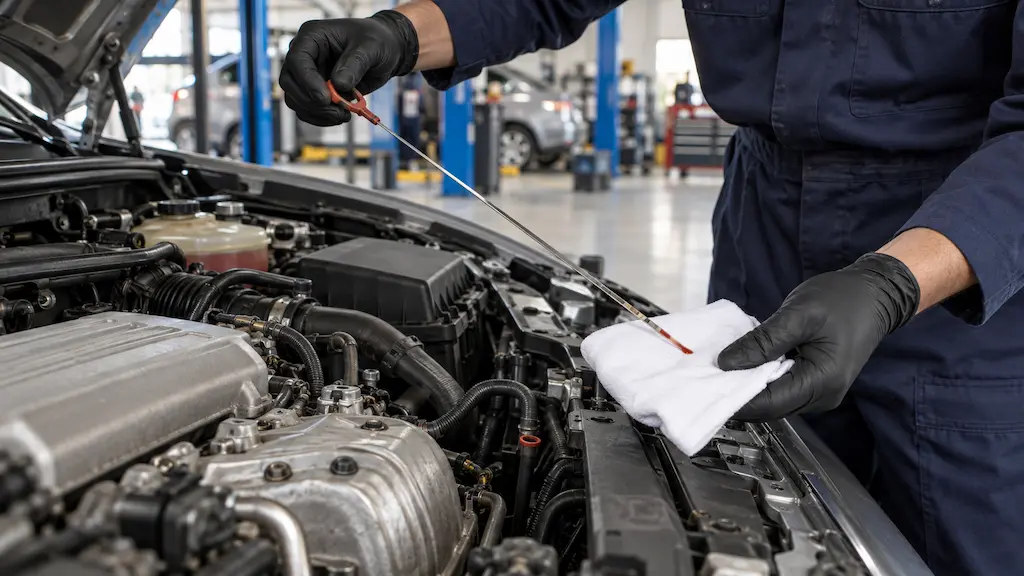

You select Drive to leave a parking space, but your car hesitates before moving. A rough gear change follows, leaving you wondering whether the transmission fluid is low or something more serious needs attention.
Knowing how to check gearbox oil level can help, but the correct method depends on your vehicle’s transmission. Some use a dipstick; others require a workshop check. At Car Experts Dubai, a car garage in Dubai, technicians can inspect the fluid level and diagnose shifting problems.
This guide explains the checking methods, warning signs, and vehicle-specific differences to understand before adding fluid.
Where Do You Check Gearbox Oil Level?
Gearbox fluid sits inside the transmission casing. Its checking point depends on the design.
| Transmission design | Typical checking arrangement |
|---|---|
| Manual gearbox | Filler or level plug on the casing |
| Automatic with a dipstick | Dedicated transmission-fluid dipstick |
| Automatic without a dipstick | Specified level-plug or service procedure |
| CVT or dual-clutch transmission | Transmission-specific procedure |
How to Check Gearbox Oil Level With a Dipstick
Use this framework only when your handbook provides an owner-accessible dipstick procedure:
- Park level and secure the vehicle, Apply the parking brake.
- Follow the specified temperature requirements, Do not assume a short idle produces the correct fluid temperature.
- Set the engine and selector as instructed, Some procedures require the engine running; requirements vary.
- Locate the transmission dipstick, Confirm its identity in the handbook.
- Remove, wipe, and fully reinsert it, Use a clean, lint-free cloth.
- Withdraw it again and read the appropriate markings.
- Investigate a low reading, Add fluid only through the approved filling point, using the correct specification and procedure.
How Are Manual and Sealed Gearboxes Checked?
Many manual gearboxes use a level opening on the casing. A technician positions the vehicle correctly, identifies the specified plug, and checks the lubricant against the manufacturer’s reference level.
Do not assume every gearbox should be filled until fluid overflows. Likewise, removing an unidentified underside plug may drain fluid rather than check it.
Never work underneath a vehicle supported only by a jack. If underside access or temperature monitoring is required, arrange a workshop check.
Toyota Corolla, Nissan X-Trail, and Suzuki Swift Differences
Toyota Corolla
Instructions for how to check gearbox oil level on a Toyota Corolla depend on its year and transmission. For example, Toyota’s 2021 Corolla Hatchback documentation lists different lubricants for its CVT and manual transmission. That documented difference shows why a Corolla nameplate alone cannot identify the correct fluid or procedure. These specifications should not be applied automatically to UAE variants.
Nissan X-Trail
Nissan’s UK 2024 X-Trail CVT manual directs owners to a dealer or qualified workshop for checking or replacement and specifies NS-3 fluid. Its separate e-POWER manual specifies Matic S gear fluid instead. These are distinct systems, not interchangeable instructions.
Suzuki Swift
Do not use a generic Swift tutorial without matching the vehicle specification. Suzuki provides handbook lookup by VIN; consult the correct handbook or dealer if yours is unavailable.
How Do You Check for Gearbox Problems?
Observe when the symptom occurs: cold starts, warm driving, acceleration, reversing, or particular gear changes.
Watch for:
- Delayed engagement.
- Repeated slipping or unexpected engine-speed increases.
- Grinding, whining, or unusual vibration.
- Harsh changes or difficulty selecting gears.
- Fluid leakage or transmission warnings.
These symptoms warrant investigation, but they do not prove low fluid or internal gearbox failure. Bosch explains that similar behavior can originate from other clutch or transmission components. For persistent symptoms, car transmission repair in Dubai should begin with diagnosis before parts replacement.
If the car loses drive, leaks heavily, or displays an overheating warning, stop safely and arrange assistance.
How to Check Whether an Automatic Gearbox Is Good
During a normal, safe test drive, assess engagement, acceleration, changes where applicable, and reversing. Avoid aggressive testing. Check the service history and request a diagnostic inspection. A smooth drive and correct fluid level cannot establish the condition of every internal component. When buying a used vehicle, a pre-purchase car inspection in provides a more useful assessment than relying on the seller’s description.
Frequently Asked Questions
Can I check gearbox fluid when it is cold?
Only if the manufacturer specifies a cold-check procedure. There is no universal hot-or-cold rule.
What color should gearbox oil be?
Color varies by fluid specification. Appearance alone cannot confirm correct level or gearbox health.
Can low fluid cause slipping?
It can contribute to operating problems, but slipping has other possible causes. Confirm the level and diagnose the fault.
Can I use ordinary engine oil?
Use only the lubricant specified for that transmission. Do not substitute products based on appearance or viscosity alone.
How often should gearbox oil be checked?
Follow the vehicle’s maintenance schedule. Investigate leaks, new symptoms, or concerns after transmission work promptly.
Will topping up fix gearbox problems?
Only if an incorrect level is responsible and the underlying cause is addressed. Topping up cannot repair worn components.
Conclusion
Knowing how to check gearbox oil level starts with identifying the correct transmission procedure. Accurate temperature, vehicle position, fluid specification, and measurement all matter.
For a check in Dubai, contact Car Experts Dubai with your vehicle details, mileage, service history, and symptoms. Request diagnosis before deciding whether fluid adjustment, servicing, or repair is needed.